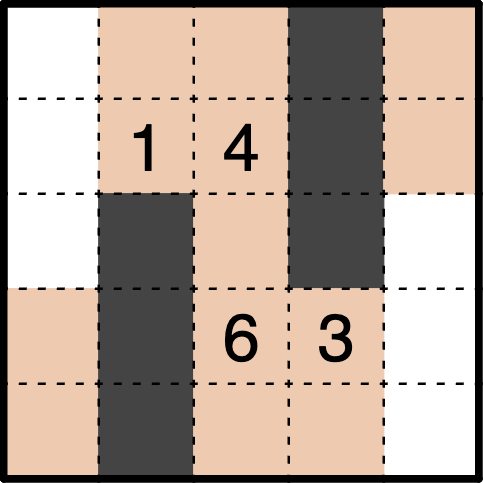
I have found mosaic puzzles provide a lot of depth when making and solving them. Some tricks can involve combining any number of the tiles on the board.
One of the more obvious solutions is indicated by providing the answer to all surrounding tiles as with the example shown below:
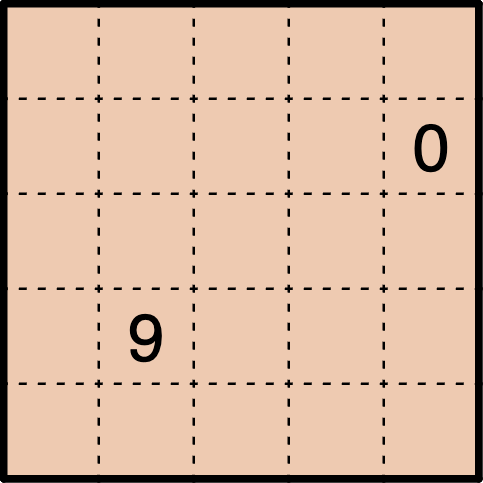
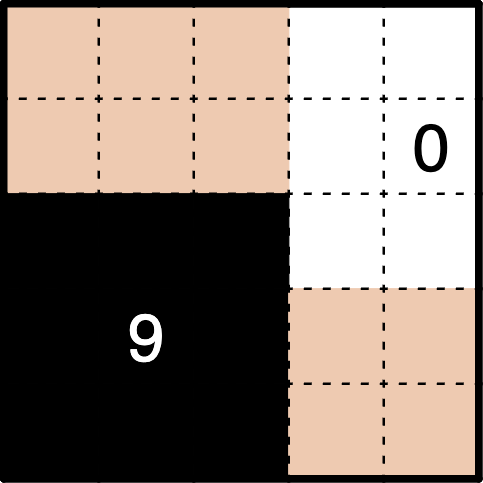
The 9 tells us that all tiles are to be shaded while the 0 tells us that no tile should be shaded.
Another less obvious trick can allow us to uncover the truth when any two adjacent numbers have a difference of 3.
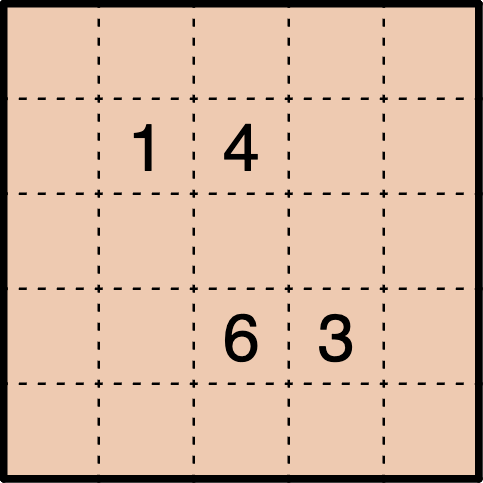
To simplify it we can consider the numbers 1 and 4 as well as the three regions they create.
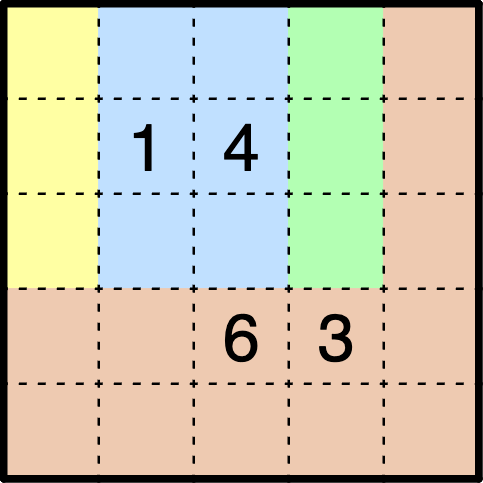
The 4 tells us that there are four shaded tiles in the blue+green region. If we consider the region controlled by the 1 we can deduce that the blue region can only have a single shaded tile. Any more wouldn’t satisfy the 1. With this limit in mind the remaining 3 shaded tiles needed to satify the 4 can only exist in the green region.
The reverse is also true, once we know the green region is shaded and the only remaining tile exists in the blue region, we can deduce that the yellow region has no shaded tile.
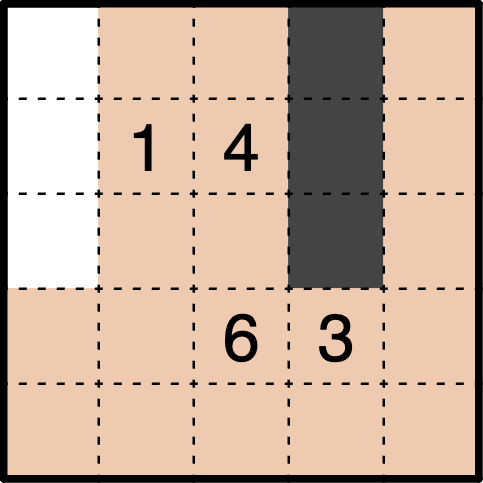
This pattern is true of any adjacent tiles that have a difference of 3.